

How to Select a Practical Bike Lane Width
Is a quick-build protected bike lane with no space to pass still better than a painted lane? What is the right protected bike lane width and how does it affect the user experience? This might seem simple, just pick a number within the recommended range from a design guide, but this post looks at a range of bike lane widths, and the practical experience of riding in them.
Let’s set out some basic paramters:
Bike width: If we look at the basic point of contact with the ground, that’s about an inch or two, the width of the tire itself, but that’s no way to calculate functional space requirements.
Pedal width: This is quite an important one. The outside edge of the pedals likely sits around 0.2m from the bike centre line. Avoiding someone catching their pedals on an object is a key safety requirement. That doesn’t mean it’s ok to build a 0.5m bike lane, but catching a pedal is a practical consideration when we start to think about the width that allows passing.
Handlebar width: The handlebars are likely the widest point on most regular bikes, a drop-bar bike might be around 0.5m, a regular commuter bike might be about 0.65m-0.75m, a mountain bike up to 0.8m, not that that should be the “design vehicle”. As the widest point it’s easy to use this metric and draw a cube around all extremities of a person riding a bike, but my experience is some people, at least those that are more confident, can ride closer to the edge of the facility when riding together or passing. Not saying that’s a desirable requirement, but it happens.
Cargo bike width: If we’re building AAA infrastructure, the regular bike is not the only “vehicle” using the facility. A cargo bike varies in width, sometimes no wider than a regular bike, but trike style bikes can be up to around 0.9m in width.
Other “bikes”: By that I mean other forms of micro mobility which could include scooters, skateboards, mobility devices, one wheels, etc, are all generally narrower than a cargo bike trike.
Space to pass: You might say that this isn’t a requirement for cars - although it is in some places such as climbing lanes, so why bikes? For cars, it’s pretty easy to push the gas pedal and drive at the posted speed limit. People riding bikes travel at all sorts of speeds, whether due to fitness, electric assist, comfort riding at different speeds, or even purpose that might vary from day to day, i.e., out enjoying a casual ride, late for work, etc. Space to pass is important. When we just had painted lanes, you could pass in the vehicle lane. When we have protected bike lanes, you probably want space to pass.
Social cycling: If we provide space to pass, that also means there is space to ride side-by-side. The challenge here, is that to stay riding side-by-side, and allow space for passing, well, we’re getting pretty wide at that point, and despite uni-directional bike lanes being preferred for many reasons, a bi-directional bike lane offers this one advantage even with a pretty narrow bi-directional width such as 3.0m.
Variation in path: It’s pretty difficult to hold a completely straight path, any facility must allow for a little variation and forgiveness. We do this for vehicle lanes, and it’s no different with bike lanes. If anything, a car is better at holding a straight line, as the steering wheel generally wants to return to centre. Guidance typically requires a 0.2m buffer to allow for natural variation in path. I’d argue on an uphill grade, you need more as there is a greater tendency to weave when riding slower. Equally, riding downhill, the consequences are higher if you were to clip a curb, so a wider width reduces the chance of that happening.
Widening on curves: Often more of a consideration for long trucks on tight curves, but equally, if we’re squeezing in a narrow lane with tight corners, or a bend-out, or bend-in configuration at an intersection, it’s worth checking that a cargo bike can make that turn.
How people ride: People will tend to ride in the middle of a narrow facility to stay away from the curb or gutter. If someone rings a bell from behind, then they’ll tend to pull over toward the side as much as they are comfortable doing, but they likely would still want to maintain a safe buffer.
What doesn’t count as width: The gutter pan doesn’t count… It’s for conveying stormwater, not riding on…
So what is the right width? In BC, we often refer to a few different design guides, and they are all consistent in what they recommend, albeit they all use slightly different terminology to describe the various widths. The legend is my own interpretation…
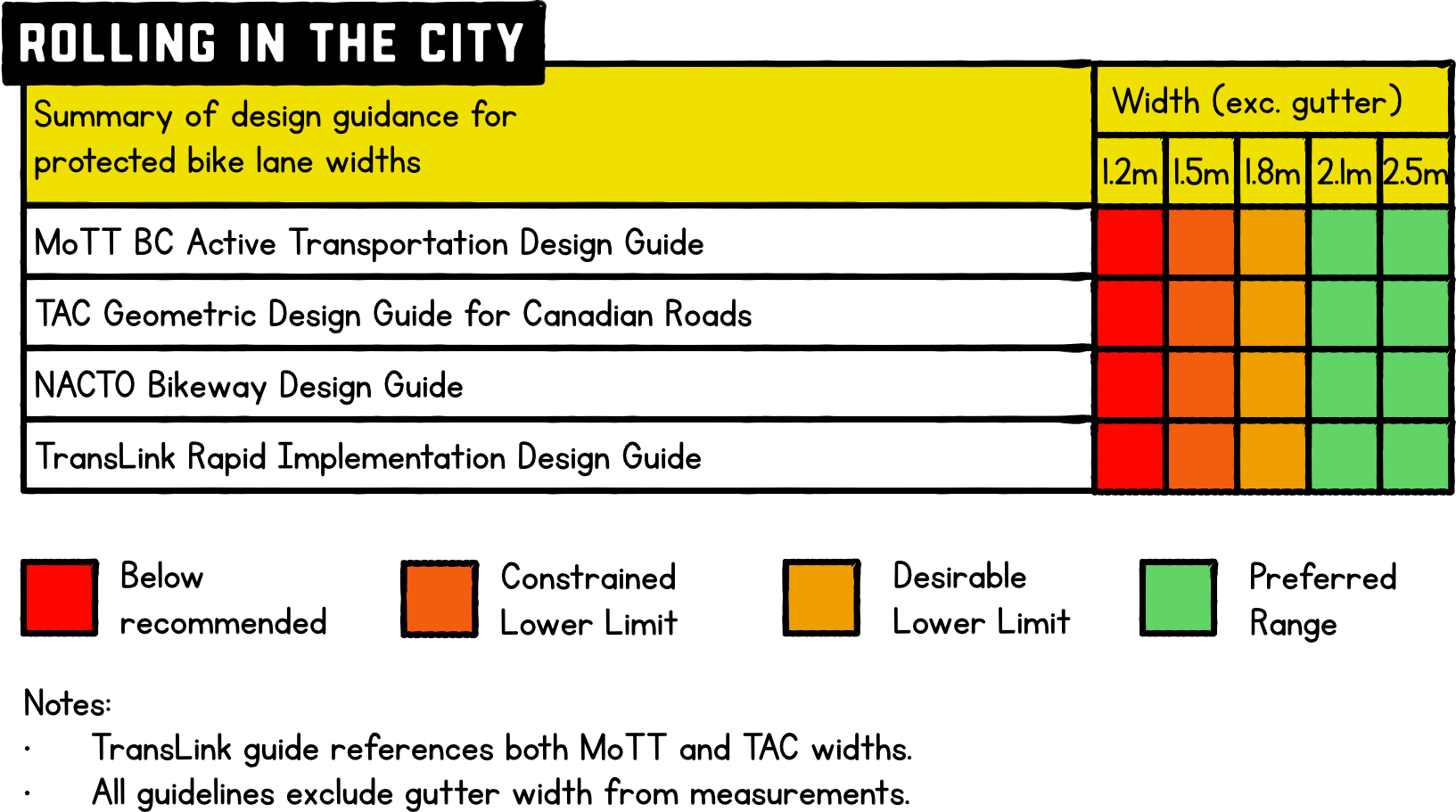
So those are the widths, what level of comfort are you willing to accept on your project? What does it look like when people ride in them? This is my subjective take on riding in protected bike lanes of various widths…
1.2m Bike Lane
1.2m is not recommended in any guideline, but has been used, and in my opinion is fine for short distances such as passing a bus stop. It’s possible to ride a regular bike with a bit of space to weave, but that starts to become challenging on a wider cargo bike. Passing or riding side-by-side is not possible with curbs at either side, but may be possible on a raised facility with favourable edge conditions.

1.5m Bike Lane
1.5m is the constrained lower limit and most guidance would also only recommend this for short distances. Riding side-by-side becomes possible even with barrier curbs at each side, but the level of comfort in this situation varies by person. It’s comfortable for some rather than most. I didn’t include the raised option with side-by-side riding as that is now comfortable and passing even becomes normal es. Passing someone riding a cargo bike is not possible with curbs on each side, and barely possible in the raised example.

1.8m Bike Lane
1.8m meets all guidance and could be considered the desirable lower limit. Passing becomes normal even with curbs on either side; passing someone on a cargo bike might be possible, but not easy. Passing the cargo bike on the raised example becomes more feasible. Social cycling is also comfortable for most in these examples, but people would have to drop to single file to allow someone to pass.

2.1m Bike Lane
2.1m makes passing even more comfortable allowing people to vary their position while allowing passing. This is where a facility truly becomes comfortable for most, especially with curbs on either side. Passing two people riding socially might be possible on a raised facility with favourable edge conditions, but only for some.

2.5m Bike Lane
At 2.5m, comfort improves further, and passing becomes very comfortable. Pass two people riding socially becomes more feasible, subject to positioning and comfort passing.

3.0m Bi-Directional Bike Lane
The uni-directional options are beginning to take up quite a bit of space within the right-of-way at this point. Two 2.5m uni-directional protected bike lanes, plus, say, a 0.5m buffer on each side, add up to 6.0m. This same level of passing comfort can be achieved in a 3.0m bi-directional bike lane. So, while uni-directional bike lanes are preferred for many reasons, bi-directional are certainly more comfortable when space is constrained.

To Summarize…
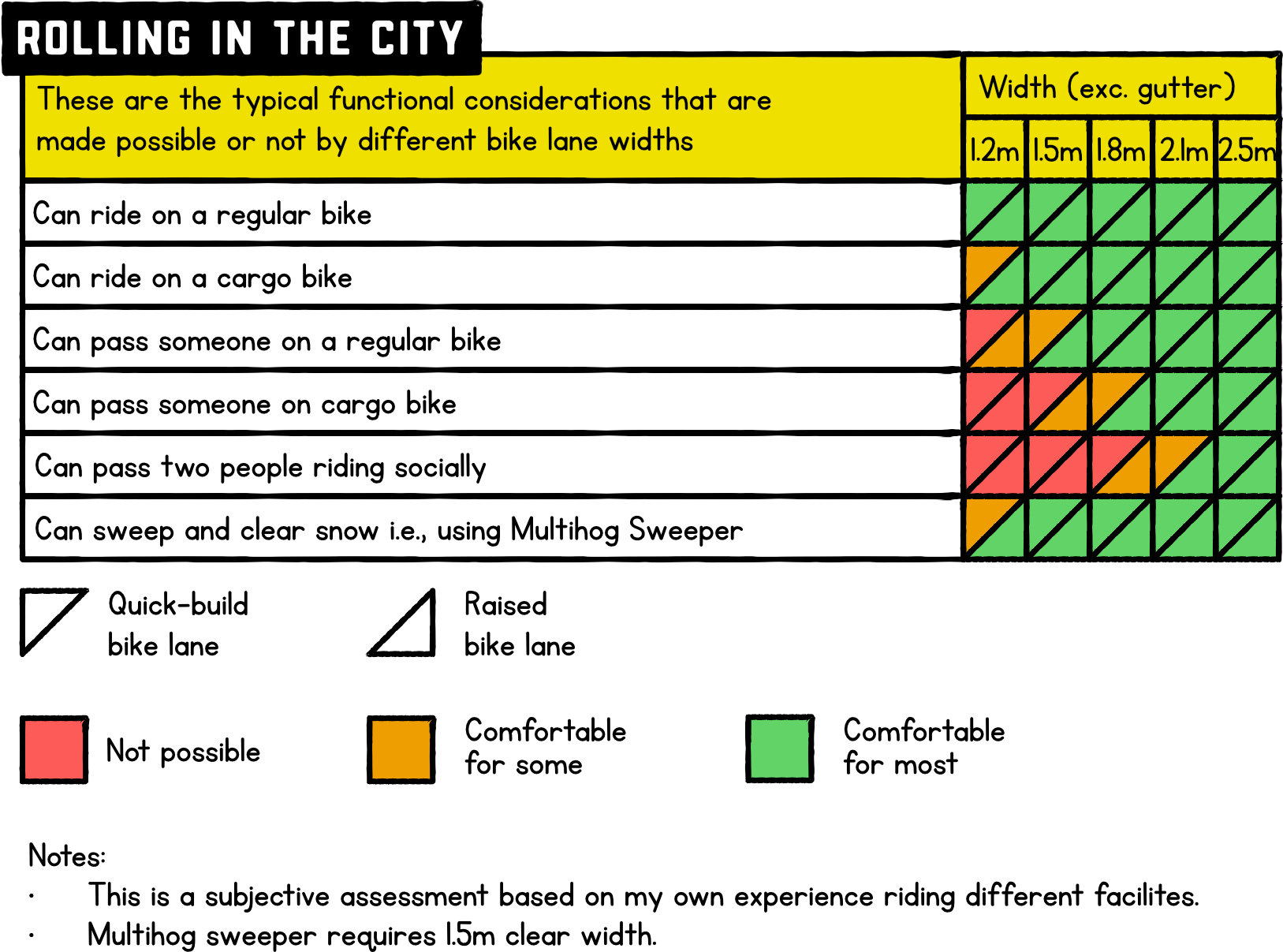
Trying to put those numbers into some sort of table, this is my take on the functionality of different protected bike lane widths…
What’s your opinion?
Does the right width depend on the project? Is a quick-build protected bike lane with no space to pass still better than a painted lane? Is a bi-directional lane better than narrow uni-directional lanes if you don’t have much space? It’s always better to go raised to remove the barrier curb at each side, but that comes at increased cost which might also be a constraint… Where is the line between accepting a constrained design and spending more money? Finally, if you do have the space, quick-build or raised doesn’t really matter…