

The 3 km Fyllingsdalstunnelen bicycle tunnel through Løvstakken mountain was about all I knew of the bike infrastructure in Bergen, Norway. Other than that, every photo online showed the same cute old buildings… I assumed a tunnel that long was an old abandoned rail line, but it’s not, it’s new, and largely purpose built for cycling from the outset. That’s quite the investment in cycling infrastructure, so what would the streets look like?
This view of all those cute old wooden buildings from the other side of the harbour… They reflect the historical centre while the side I’m standing on is the modern city centre…
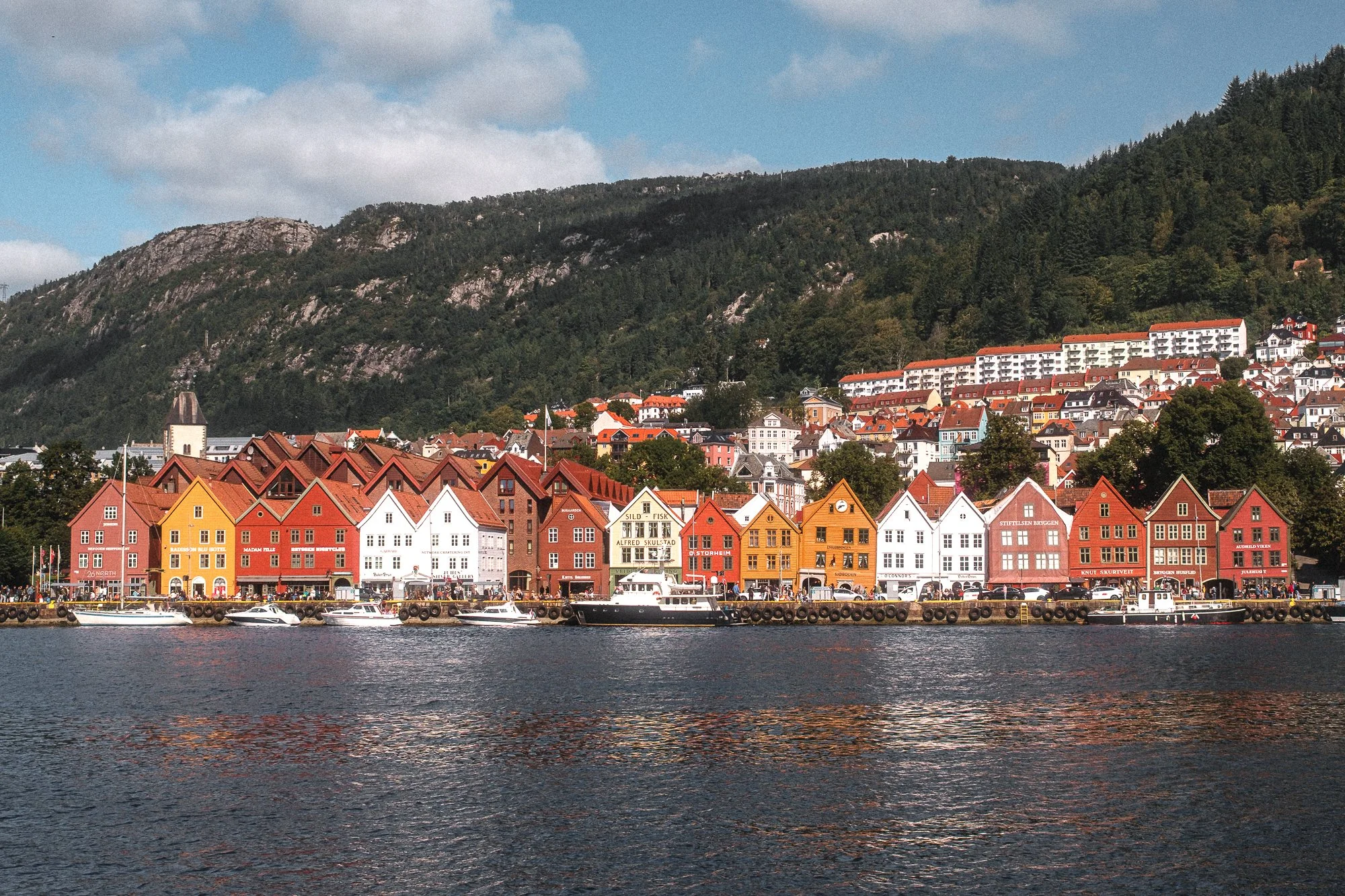
We’d explore the main centre later… First, with only two full days in town, we’d do the tourist thing and go and see those old buildings and streets… These bike share bikes on the way there are now just a moment in history… We didn’t use these while we were there, as the shared scooters just seemed easier being electric, and more convenient given we already had the apps. But as I write this blog post a couple of months later, I found out that Bergen City Bike ceased operations on November 1st… From what I can find online, it was a subsidized service by the City and not renewing the contract was a way to cut their budget. Compared with the competition, which presumably the City allowed, the bikes were heavy and weren’t electric, so they were always going to struggle against powered options…
Big crowds outside the phone booth library… There was a rumour going around town that there was a copy of fietspad in there…
Behind those old frontages… It does feel a bit like stepping back in time, or onto a movie set… Imagine including this as a street typology in your next design guide… If you can imagine that, there is a contact page above…
Looking for views as we make our way up the hillside behind those buildings…
Working our way further up the hillside, some pretty normal looking streets, narrow and one-way by the looks of it, low posted speeds, and parking restrictions that seem to translate to it being ok to park with a permit or if you pay…
Could use some curb ramps on that corner… But the sun on these buildings… Even where the road is asphalt, curb and gutter is just rows of bricks…
Plenty of people taking shared scooters up the hill to this neighbourhood… If this is a designated parking area, it looks a bit narrow… No city bike share dock here though so you can see the attraction of Lime…
And getting to the end of this neighbourhood north of the centre, we make our way back down to the water. When everything is uphill or downhill, an overpass is an easy design choice, and roads and pathways, bridges and tunnels cross over each other…
A bus stop with real-time information which seemed to be the norm… Hard to tell frequency here, but a bus seems to come pretty often. At a guess, those three heads by the time seem to suggest the buses aren’t super busy at this time, which if I recall was a Sunday evening…
High likelihood of collisions… A sign will fix that right… Or maybe better yet, a redesign to make it slow and safe… There does seem to be a new bike path being built in the background, hard to say if that will address this specific issue…
Cute houses, people on bikes, sun coming out…
That construction above looks like it’s an extension of this… A pretty nice wide bike path following the coast… Nice TWSI’s…
As we walk back towards the centre, that bike path sits immediately adjacent to the vehicle lanes, separated only by the wide barrier curb. A small mountable curb sits between it and the pedestrian path… Also, just confirming that Norway has pigeons…
The first bike tunnel… It’s not the 3 km one, but it seems there’s more than one tunnel around here…
More cute buildings, bicycles, and good light…
Roadie using the bike path… I’m actually wondering if this road is bus only or something at this point?
A giant island platform bus stop, albeit the sidewalk goes that way too, so is it an island platform? The bike path and sidewalk just cross-over… The challenges for those with sight loss are no different though… That is someone knowing if there is a person approaching on the bike path, and if that person is stopping for them… TWSI’s at least taking care of wayfinding…
Back in the centre, away from those cute old buildings, it’s looking a lot more like a normal city…
A lot of people riding the sidewalk here… I’m thinking to avoid the cobbles as they come from the central plaza a block or so away…
That central plaza looking back to those hills to the north…
A central park with a fountain and pond, and another shot of the now closed bike share system next to a bus stop… As you see from the photos, it was clearly being used… Delving more into the decision to close the system, the non-powered, heavy, traditional bicycles were a struggle for most on Bergen’s steep hills, and it seems the contract simply ran out with a better solution needed. Rather than contracting a single standalone bike-share vendor, it looks like the City will enable the established micro-mobility operators like Lime, Ryde, and Voi to deploy shared e-bikes alongside their existing e-scooter fleets, providing powered options that work better for more people and to more destinations in this hilly city, but likely at a higher cost to the end user?
It took a bit of looking but we found a protected bike lane in the centre with a somewhat unique crossover to switch the bi-directional lane to the other side…
I think this tunnel is just a shortcut to the other side of the hill, maybe one-way as there’s not much allowed in from this side based on the signage… If you need a tunnel dug though, it’s seeming like the Norwegians are pretty good at that…
A shared e-scooter corral keeping things neat and tidy up the top of the hill above… As I said earlier, we chose scooters over the conventional bike share given we already had the Lime app and the power would get us up those hills with ease. We bought a pass for 199 NOK (Norwegian Kroner) (About $30 CAD) and that got us 300 minutes which could also be used for group rides. The value was ok for us as tourists, but even if you lived here and had a short commute, it would be reasonable value to get across the city with ease every day. Apparently we could have had a 3-day pass for the now defunct bike share system for 119 NOK and a day pass was around half that. Much cheaper, but also much more effort…
This street has San Fransisco vibes with it’s steep switchbacks…
Small streets at night… Pick your gutter width… 1 brick, 2 bricks, or 3 bricks…
The next day with scooters acquired we head to the bike tunnel… Leaving the centre, an elevated concrete highway distracts from the view behind… You don’t see that in the tourism photos… I was going to say it might be a good candidate for a tear down given it kinda ruins the view… However, just off the left of the photo below it enters a tunnel through the mountain and pops back out north of the city. Where you see it here, it’s passing over railway tracks, so it kind of is what it is…
Elevated concrete highways are often considered a blight on the landscape… Do you think the same of an elevated concrete bicycle highway? It is different, I immediately think, oh wow! They invested in this huge structure for people riding bikes…
It just doesn’t seem as bad… But it makes me think about the type of structures we build and the visual impact they have on the surrounding environment… This structure that i’m standing on snakes left over the railway tracks and carries on up the hillside. It isn’t exactly pretty, but it’s making it easier to get around for people walking or rolling…
A pre-big bike tunnel, little bike tunnel…
A Dutch style protected roundabout on route…
The path continues under an elevated parking lot for the adjacent buildings…
Then we turn right into the Fyllingsdalstunnelen… It’s a rather unassuming entrance for something listed as a tourist attraction on Google Maps… You might notice another tunnel to the side and that would be the new light-rail tunnel. While this is purpose built for cycling, it provides an essential secondary function as a safety and emergency escape route for the adjacent rail line. It didn’t have to be as big for that purpose, and the wider facility and upgraded design added about 300 million NOK (~$45 million CAD) to the project budget compared with the cost of conventional escape tunnel. That’s a lot for 3km of infrastructure… I didn’t notice the bike counter at the time, but on this day there were 376 or 876 bicycle trips and 97 pedestrian trips… The sign on the left states it is closed between 23:30 and 05:00 on all days…
It was pretty cold in the tunnel as it’s apparently kept at around 7 degrees… This sign shows how the colours inside change as you move along, I’m guessing to make it feel less monotonous and show that you’re making progress…
There’s some patterns along the wall to add interest and the roof in most of these tunnels seems to be lined with some form of presumably waterproof fabric. I’m guessing to stop the drips that are typical in an unlined tunnel…
The half way point is marked by this sun dial of sorts with a little seating area… I’m not sure it’s a great place to hang out honestly, but good for a few tourist photos, maybe good if you need a rest too, as it’s also slightly uphill in one direction…
Not just a bike tunnel… There’s a separate pathway for people walking too…
Popping out on the other side, we followed a designated cycle route back towards the city centre which started out reasonably, switching sides here and there, but we pretty much ended up on what seemed like a sidewalk that was less than ideal…
For example…
Back in the centre after our little scooter tour, loving the ease with which we were able to explore. The only downside is that I was often reluctant to stop and take photos… The rider below taking the lane… Sharing the road is a different experience than in North America, traffic volumes and speeds generally seem much lower, and for some reasons when we were on the road it felt less like we were in the way… However, on this one which is the main route between the modern centre and the historic centre, it could still use a protected bike lane in my opinion…
A bit to steep for the run bike…
Another of those telephone booth libraries… Based on the signage inside, they do seem to be quite official, unlike the more casual libraries we see dotted around Canada… No copies of Fietspad here…
A raised crosswalk, full height with pavers and TWSI’s…
I’m not sure how common continuous sidewalks are here in Bergen, this was the first I really noticed… Maybe continuous is the wrong word, it’s raised, but the material changes. However, it still feels like a car is crossing the pedestrian realm which is the main point… I like the little abrupt curb ramp which is very much like the Dutch version. No driver is turning at speed into this street… Nice cargo bike…
Just people biking, walking, listening, and chilling…
Places to sit outside…
And a few more…
People rolling by…
Bergen station at 7.20am and far too early for our train to Oslo. First time doing such a long train journey at 7.5 hours but it passed pretty quickly, the scenery helping for sure…
A preview of what a Sea to Sky passenger rail service might look like…
A glacier at 1,222 meters elevation… Right outside the train window… That’s pretty amazing…
How does it compare?
In the last blog post we didn’t really have any expectations around the bike network in Reykjavik, and were pleasantly surprised, but for Norway, we sort of did, albeit with little basis… It’s in Europe, we keep hearing it has oil wealth, so it should be pretty good right… Here’s what the bike network looks like on a map…
If you zoomed in on the centre, you’d see a pretty intermittent bike network, and that is definitely the experience. Having said that, we never really felt in danger when sharing the road as I said earlier, speeds and volumes of traffic were generally low. What they have built though felt pretty good, and is maybe a sign of things to come… Just like here in BC, and like many places even, they’re just not as far along in their journey as say the Netherlands…
We’ve pulled the data and added it to the benchmark page alongside the others. With around 295,000 people in Bergen, spread across 465 square kilometres, the city has a population density of around 630 people per square kilometre. That’s less than the BC median of 928, about a quarter of the Netherlands at 2,541, and more than the Reykjavík Capital Region at around 400.
Bergen’s network density of 0.45 km per square kilometre matches the BC median, but is well short of Reykjavík’s 1.11 and the Netherlands’ 3.06. With a large natural area within the boundary, network density was never going to be it’s strength, so per capita, it does a bit better, with 0.71 km of all ages and abilities bike infrastructure per 1,000 residents, that’s ahead of many BC cities, but around half the Netherlands average, and about a quarter of Reykjavík at 2.69 km.
Norway in general felt very much like BC with large areas of nature, and its bike network focussed in the urban areas, albeit still lacking in many places… Oslo is up next, how will it compare?